Classical CD Reviews
  • Home
  • About
  • Blog
  • Contact
  • Home
  • About
  • Blog
  • Contact

CD Reviews

Surprisingly old-fashioned (and kinda fussy) Beethoven

1/8/2024

0 Comments

 
Picture
Picture
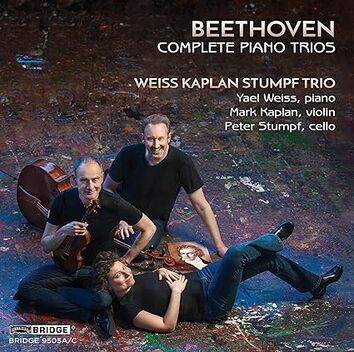
After enduring the impossibly fussy Mozart Piano Quartets on Chandos last year, here comes a not-quite-as-fussy Beethoven Piano Trios set on Challenge Classics. And in both cases, it is the piano playing which is cause for concern. But I’m getting ahead of myself.
 
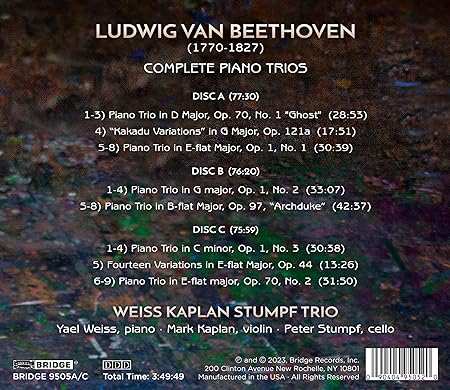
I must start with a general observation about the production itself, which is a bit unique - possibly helpful (to some), but certainly irritating (to me). These Trios are not laid out in chronological (or numbered) order. Instead, they are assembled for maximum disc length in order to squeeze them all onto just 3 CDs, whereas the usual layout involves 4 (or even 5, depending on additional fillers).
 
So economically, it’s nice, right? (And you can be sure it’s better for Bridge than it is for the consumer.) But musically, it’s absurd. Just glance at the back cover (pictured above) to see how these are presented and then figure out how you’re going to go about listening to them.
 
But there might be another reason behind this layout - one perhaps only they are privy to. After listening to the entire set, I concluded the very first work presented on CD1 (Opus 70, No. 1 - the Ghost) is by far the best performance of the lot. And that can make a difference if you listen to it in the order they want you to, because it makes a strong, favorable impression right up front which they’re hoping will influence the listener in that direction throughout all the rest. As opposed to what I did. I listened to these in order, skipping over the Ghost and going directly to track 5 to hear Opus 1, No. 1 first. And I was not impressed in the slightest. And, sadly, that feeling persisted throughout my listening to the rest. (At least until I heard them play the Ghost. But I’m getting ahead of myself again.)
 
My observations in this review apply almost entirely to everything but the Ghost. (And I'll get to that soon enough.)

In general, I find this to be rather fussy Beethoven, with some self-conscious rubato cropping up just about everywhere. Also troublesome is some uncertainty in interpretive approach from the 3 players as a coordinated, unified ensemble. The violin and cello seem to be in sync with each other regarding such matters as articulation and phrasing, while the pianist just does her own thing - seemingly unaware of what the others are doing musically.
 
In the Opus 1 Trios, it’s in the scalic passagework where this is most obvious. The strings play with precise, articulate bowing - producing fairly crisp, clean, rhythmically secure passagework (though it’s not quite spiccato). While the piano responds with legato, almost mushy passagework. (I call it “blurred”.) And the problem is that it’s just not quite rhythmically secure. I hear it as over the top - just managing to get in all the notes in the right amount of time. This observation persists, where I often became aware of this odd “blurring” in the piano playing. I might not mind it as much if they all were doing it, but Yael Weiss alone plays this way. In the more mature works, matters of articulation are less bothersome, and rubato becomes more of a distraction.
 
Interpretively, you will hear quaint Beethoven trying to be charming - and not quite succeeding. It’s just a little too temperamental and overly-Romanticized. And tempos are generally a bit too relaxed for my taste. These are surprisingly old-fashioned readings - the very opposite of fresh and invigorating. And frankly, it’s a little bland. I’m not sure that’s exactly what this group was striving for, and it’s certainly not what I want to hear in Beethoven.
 
You'll also hear a touch of “historically informed” string playing, often with minimal vibrato and sparse textures. However, they don’t get obnoxious about it, but retain a sweet, silky tone at all times. As a matter of fact, violinist Mark Kaplan plays with an alluring variety of color, textures and vibrato speeds. I especially love how he plays soft passages sotto voce with an almost muted sound. There is a vibrancy to his pianissimo which seems to resonate in the wood of the instrument more than the string. It’s hard to explain, but it’s absolutely lovely to hear. As a matter of fact, Kaplan’s violin playing makes this set worth listening to.
 
But that’s as far as historical insight goes here (other than all repeats being observed, which is a plus). The piano often plays with too much pedal and certainly too much rubato, veering ever so close to affectation (sometimes sounding downright awkward, like in the final movement of the Archduke). And as noted above, tempos are nowhere near what we might expect from a historically enlightened group. 
 
Another thing you’ll hear is very good recorded sound from Challenge Classics. The acoustic is warm and relatively clean (if not quite as airy or spacious as the very best). And the piano is naturally balanced behind the strings.
 
Just as I was about to finish up, I remembered I had skipped over the opening tracks of CD1 and hadn’t listened to the Ghost. (And this illustrates another reason why I hate the layout. Getting through these is quite a chore, which is unacceptable.) So I dutifully went back to it and witnessed the group come alive! with a newfound vitality largely missing from all the rest. At last I hear commanding, articulate, energetic playing from all three players. And tempos are invigorating. This finally sounds like what I was anticipating from this group. Their playing is vigorous without being aggressive, which is not always easy to achieve in this work. 
 
As good as this is, it alone can’t redeem what is overall a disappointing set. And I can't imagine why so many seem to like it (based on various reviews elsewhere). There are two far superior recent ones I can name - the even more complete set played by Trio Elegiaque on Brilliant Classics (2012, 5 CDs), and even better, the Xyrion Trio’s comprehensive survey on Naxos (2004-2013). Both those sets feature crisp, alert playing; unified precision in interpretation; lively, vivacious tempos; a pervading sense of spontaneity; and even clearer, more immediate recorded sound. 
 
Perplexed by this new set, I explored the booklet for possible explanations. I stumbled across something informative in their bio, which describes the group as “combining the talents of three award winning soloists”. And there it is. That’s exactly what I hear - three soloists playing together but perhaps without a solid, unified agreement as to interpretation. They just don’t quite “gel” yet. Their bio also tries to convince us they bring “authority, energy and passion” to each performance. Well, that may be when performing live, but I don’t hear enough of that in these Beethoven recordings. There is a good amount of it in the Ghost, but not enough elsewhere to be persuasive.
 
I also discovered in the booklet that these recordings were made back in 2019 and are only just now being released on CD in late 2023. How odd. I realize the pandemic put a halt to production for some time, but with this already “in the can”, I wonder why it was delayed 4 whole years.
 
Whatever the reason, and despite the annoyance with the layout, the production is first class - especially the booklet. In addition to useful information about the music and musicians, it also contains personal essays from each member of the group, summarizing their approach to, and experience with, playing Beethoven - which I found most interesting.
0 Comments


Leave a Reply.

    Author

    David Rowe

    Categories

    All

    RSS Feed

Proudly powered by Weebly