Classical CD Reviews
  • Home
  • About
  • Blog
  • Contact
  • Home
  • About
  • Blog
  • Contact

CD Reviews

This is a hodgepodge of some Chandos leftovers, but there is one real gem here.

8/7/2023

0 Comments

 
Picture
Picture
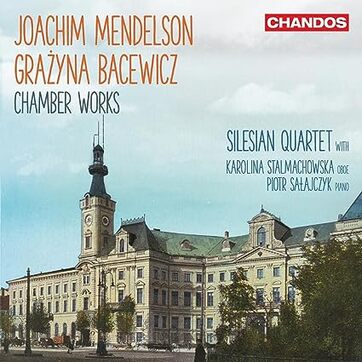
​I saw Grazyna Bacewicz listed on the front of this CD and thought, oh, yet another Chandos release of her music. But I was happy to see another composer with whom I was not familiar, the Polish composer Joachim Mendelson, and bought it anyway. As I began listening to his String Quartet #1 (which comes first on the CD), I was struck by the free-flowing, spontaneous nature of the music. And was drawn in even more by the involving, characterful playing of the wonderful Silesian Quartet. 

Mendelson (who, interestingly, was afflicted by "dwarfism") was born in Warsaw, trained there (and later in Berlin) before settling in Paris. And this is reflected in his music, which contains an interesting combination of Polish and French influences. He composed this string quartet while in Paris in the early 30s and the distinctive French flavoring is present throughout.

The 1st movement starts a little hesitantly, with some unexpected discord which sounds for all the world like clunkers - some wrong notes being played. While it’s a little unusual, one can be assured it’s all intentional; the Silesian Quartet surely doesn’t make mistakes! The music is playful, coquettish even, in an opening movement which is endlessly varied. In fact, there are no fewer than 14 different tempo indications prescribed in this movement alone! Curiously, the booklet writer goes into great detail describing this movement but then fails to even mention the following two movements, moving on directly to another work on the program instead. How completely odd.
 
Fully engaged in the variety of moods on display, Debussy eventually makes an appearance and strongly influences much of this music, though there remains a prevailing con spirito feel. The Largo introduces us to a more lyrical side of Mendelson, although a truly memorable tune doesn’t quite develop. Instead we hear snippets of what are essentially a series of repeated motifs played in succession. And the sweetly singing, expressive playing of 1st violinist, Szymon Krzeszowiec, brings them together in a melodious, thoroughly gratifying way.
 
The finale is an engaging Scherzo giocoso, with quirky themes passed around among the players, almost as in a fugue. And a brief, extended tune soars in the high violin sounding very much like Ravel, whose influence can be heard throughout this section. The music continues with charming, articulate motifs before ending deliberately with some more “wrong” notes. This was most enjoyable and rewarding from beginning to end. It is a real find.
 
Immersed in the music, thinking what a wonderful composer this is, I was lulled into a relaxed state of contentment when I was startled by a sudden boost in volume as the CD continued playing the next track, presenting the same composer's Quintet. Obviously recorded in different sessions in a completely different acoustic, the overall perspective is thrust forward, now with a disconcerting closeness to the players. A piano has unexpectedly joined the group, sounding rather clanky (and with a touch of a hard glassiness) in the mix. Soon, an oboe also makes an appearance, surrounded by an unnatural halo of digital glare which was completely absent in the string quartet. Further, the acoustic is now swamped in a pronounced reverberation affording the music-making a somewhat noisy, clamorous quality (much like that heard in several Chandos recordings of the Kaleidoscope Chamber Collective). This elicited quite a reaction from me and I grabbed the booklet for an explanation as to what on earth has happened here.

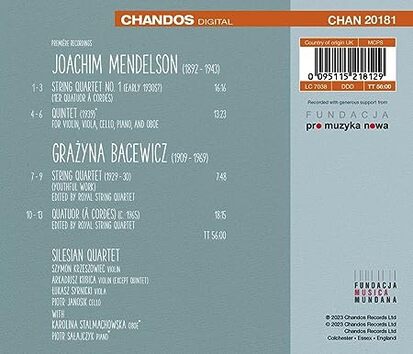
I quickly discovered what Chandos has done. The recording information reveals this release is essentially a compilation of some older (presumably abandoned) recordings used to fill up a disc of two more works by Grazyna Bacewicz to round out their ongoing series of recordings of her string chamber music. The Silesian Quartet has already recorded her 7 numbered String Quartets (2016) and 2 Piano Quintets (2018), and these unpublished string quartets on the current release supplement those. 
 
What they've come up with is Mendelson's string quartet, recorded by the Silesians over 14 years ago (clear back in 2009), and his oboe quintet, recorded in 2015, as companions for the two new Bacewicz recordings (2022). The booklet does not make clear whether these recordings were Chandos originals or acquired from other sources. Regardless, the CD is entirely produced by Chandos. And putting them all together - voila! - we’ve got a CD lasting 56 minutes. 
 
And this concept would be fine; but geez, Chandos, could you not have made any attempt whatsoever at level matching the various recording sessions? And make an effort to clean up the glarey haze around the oboe? Even in the digital realm, remastering techniques do exist and can be beneficial with a willingness to try.

More important, I am baffled why the recording of Mendelson's string quartet had never been released. It is a wonderfully inventive piece and well recorded. His oboe quintet is interesting as well, but is so poorly recorded I can understand why it had apparently been discarded. In this current compilation, the string quartet fits in perfectly well with those by Bacewicz. However, I found the oboe/piano quintet distinctly out of place here on this program of string quartet music. 
  
Be that as it may, it is enjoyable enough if you can listen through the reverberation and glarey halo surrounding the oboe and adjust to the different instrumentation. The 1st movement Allegro scherzando is delightful actually, and the Lento which follows features a gorgeous, extended passage for just the cello and piano. It is Romantically inclined, richly melodious and intimately appealing. Interestingly, the recording in this passage sounds wonderful (and much more natural) before the oboe makes another appearance, bringing the glarey halo with it. And the muddy acoustic again distracts in the concluding Allegro con brio, which is imbued with the harmonic resourcefulness of Debussy. Despite the recording quality, it is an alluring creation.

Moving on to the main offerings Chandos really wanted to present, the recorded sound returns to their usual high standards and we enter the soundworld of Bacewicz, which is really quite different. Incidentally, these are unpublished scores which the composer rejected and did not include in her catalog of works. But the Silesians decided to record them anyway. And in the end, they're worth hearing.
 
The first string quartet is an early student work lasting just under 8 minutes. It is cast in 3 movements, though they all sound much the same. This is some of her most atonal music. There is an attempt at melodic invention in the 1st movement, but it just doesn’t quite get there. However, just as in the Mendelson, Krzeszowiec's playing almost convinces us otherwise - especially in the soaring second subject. I marvel at his sweet, expressive tone, which isn’t at all sentimentalized, but rather simple, lovely, often tender and utterly ravishing. I could listen to him playing just about anything all day long.
 
Fortunately this little piece doesn’t last too long. There is a very short adagio (1’34) followed by a difficult fugue occupying the finale - both of which reminded me of a Bartok string quartet.
 
The final quartet is a late work, coming 35 years later in 1965, just 4 years before Bacewicz's death. And it is a little weird – experimental in non-tonal sounds and sonorities, somewhat reminiscent of 1960s Penderecki and Ligeti, but without their revolutionary vision. The 1st movement Allegro is indisputably atonal and incorporates interesting ¼-tones and deliberate sliding from note to note, creating intriguing atmosphere and dissonance. Unfortunately, she also employs the use of dense note clusters which are unpleasant just for the sake of being unpleasant. I can find no compositional reasoning or musical justification for their inclusion. The Grave is much the same, but with even less forward motion. However, from within this desolation there emerges a brief rhythmic interlude which perked up my interest, followed by a fascinating passage of unusual glissandi creating a mesmerizing landscape through to the end of this section. 
 
A brief Capriccioso takes the place of a true scherzo and is conspicuously light-hearted. With barely a hint of tonality, it is created with rhythm and articulation, punctuated by pizzicatos. Deliberately lightweight, it can come off sounding a bit trivial, but I have to admit I rather liked it. The final Maestoso is similar to the Grave - sounding even more like Bartok but with some interesting, advanced bowing effects.
 
There is so much in this final work which had the potential to be Bacewicz's masterpiece. If only she had thought enough of it to revisit it one last time before it was too late, I think it could have been exemplary with some revision (i.e. tightening up the structure, further developing the most progressive sections, and replacing the unpleasant tone clusters with true compositional substance). As it is, it remains a compelling example of her innovation and creativity. 
 
In closing, I can conclude we’ve had enough Bacewicz now. Really, we have. The recent explosion of interest in her music has produced numerous recordings on a variety of labels. Those on Chandos alone have revealed much of her best (the Violin Concertos for example), and some not so much (her numbered string quartets are certainly difficult to enjoy) - and now they're even delving into her discarded, unpublished music. Let’s just leave it at that. On the other hand, this disc is revelatory in introducing us to the interesting, innovative and captivating music of Joachim Mendelson. Can we explore his music further, please?
0 Comments


Leave a Reply.

    Author

    David Rowe

    Categories

    All

    RSS Feed

Proudly powered by Weebly