Classical CD Reviews
  • Home
  • About
  • Blog
  • Contact
  • Home
  • About
  • Blog
  • Contact

CD Reviews

Well-recorded Poulenc chamber music in variable readings

4/24/2022

0 Comments

 
Picture
Picture
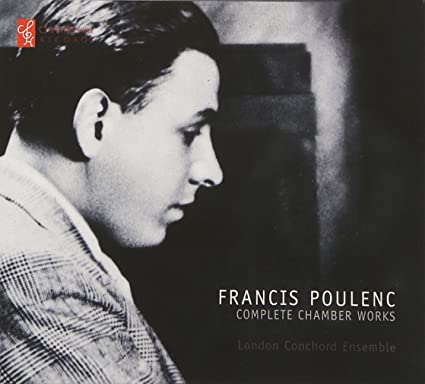
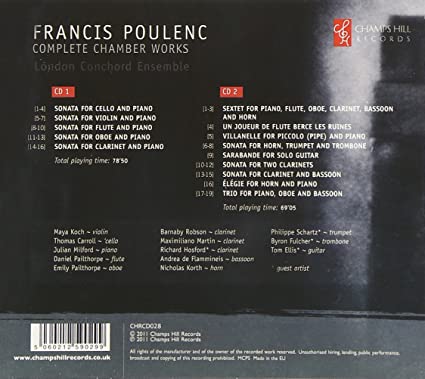
This 2-CD set of Poulenc's chamber music is not a new release but was assembled and released in 2011. However, I've just acquired it and the label (Champs Hill Records) and this group (London Conchord Ensemble) are both new to me. And what a pleasant surprise it is!

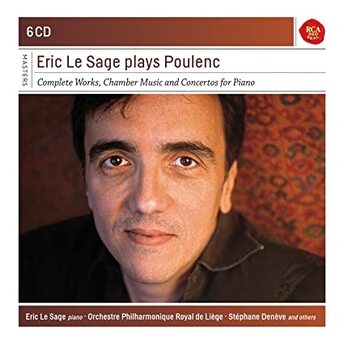
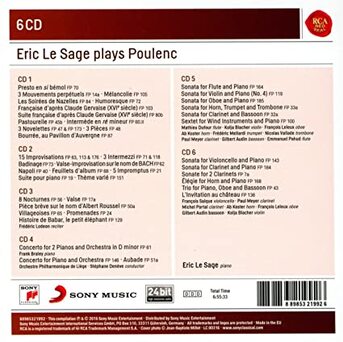
Eric Le Sage's landmark complete set for RCA has long been my go-to choice for all things Poulenc. Most of it was recorded in 1998; the Concertos in 2003. The set is incomparable for its completeness (it includes all the chamber music, solo piano music and the concertos) and for its vivid, characterful and musically involving playing from pianist and soloists alike. The entire set (6 CDs in all) has been reissued in a 2016 SONY budget box with 24-bit high resolution remastering and it remains the standard by which all others are judged. Thus it's difficult to find other recorded accounts which can match it.  

Pianist Julian Milford and the London Conchord Ensemble make a commendable stab at it. And much of it is quite rewarding. Making this set particularly special, aside from the fabulous playing, is the superb recorded sound from Champs Hill. As good as the RCA set is, it has its occasional moments of "digititus". (I borrow that word from Stereophile magazine writers who sometimes use it to describe early digital recordings or inexpensive CD players.) In this case, there is just a hint of digital edge here and there and occasionally a touch of glassy hardness to the piano tone. However, overall, it has stood the test of time, musically and sonically, and is the Poulenc I turn to for sheer enjoyment.

Listening to this newer collection from Champs Hill, it is instantly apparent this is state-of-the-art digital CD sound. It is at once more relaxed, colorful and atmospheric than the RCA, yet with a believable dimensionality and communicative intimacy. There are times, though, when I still prefer the bold, dramatic presence of the RCA, which is superbly involving and can't help but provide a tremendous impact. But generally, the newer set sounds positively lustrous and most pleasing for repeated listening.

Before getting to the music, I have a few issues with the production to address.

First, I am aware that at least half of the music contained here was originally released on ASV in 2007. Champs Hills Records label was founded in 2010. Presumably they acquired these tapes from ASV, but nowhere in the booklet is this information disclosed. 

Second, no less than three clarinetists are listed in the roster of performers, but the booklet fails to identify which one is playing in which piece. I suppose it doesn't really matter, as they are all equally fantastic. But it would have been nice to know.

And while I'm at it, I suppose I have a third issue as well - that pianist Julian Milford is not more prominently credited for his inestimable contribution here is lamentable. This really is his collection, as he is featured on almost every piece, much of it very difficult music. Alas, he is merely listed as a member of the group.

​Quibbles aside, as to the music itself, the playing is uniformly excellent by all involved and the music-making thoroughly rewarding (with a couple exceptions - see below.)

Let's start with the highlights.

Along with the fabulous piano playing throughout, the clarinet playing is dazzling everywhere it occurs - in the Sonata for Clarinet and Piano, the Sonata for Two Clarinets, Sonata for Clarinet and Bassoon and in the Sextet. Variably, these are played by either Barnaby Robson or Maximiliano Martin (or both). A third clarinetist, Richard Hosford, is also listed as a "guest artist". I'm not sure why one was needed and there is no indication as to which piece he is involved with.

In the main Clarinet Sonata, we hear an amazing display of tonal variety, dynamic contrasts and the most exquisite pianissimo legato. There is no fading in and out, or any hint of a hesitancy of the tone to "speak". Here is a miraculous technique which produces rare beauty and control in clarinet playing. This is precisely why it sure would be nice to know who is playing it.

Another highlight is the outstanding horn playing of Nicholas Korth in the Sextet. His commanding focus of tone and articulation, along with an arresting dynamic range, are extraordinary - and very impressive indeed. 

Speaking of the Sextet, this account is extremely enjoyable overall. There are several really good recordings of it which I know well, but this one is so memorable it had me whistling its many tunes for days afterwards! It is notable for strong characterization of the many moods and ever-changing tempos, a pronounced observance of articulation markings (accents, etc.) and striking dynamic contrasts. And of course, that the horn steals the show tickles me no end. 

The Sonatas for Oboe and Cello are also excellent (played by Emily Pailthorpe and Thomas Carroll, respectively), and the expert recording team affords each of them an impressive immediacy, increasing musical involvement. I can't remember enjoying them more than here.

A couple oddities are included, neither of which is technically "chamber music". The short, melancholy Sarabande for Solo Guitar is beautifully tender, played with an amazingly sustained, singing legato by guitarist Tom Ellis. I had never heard it before and would never guess it comes from the pen of Francis Poulenc. I enjoyed it very much and wished there was more to it. The same goes for the one-minute-long Un Joueur de Flute, its haunting, "whooey" sound reminiscent of Debussy's Syrinx. There's also one that Le Sage omits: Villanelle for Piccolo and Piano (originally written for bamboo pipe, the "modern" rival to the recorder in the 1930s). Lasting just 2 minutes, its loveliness was over much too soon.

Unfortunately, the remaining three Sonatas are somewhat disappointing. The one for Trumpet, Horn and Trombone is a weird little piece that I've never much cared for. And listening to it here I'd surmise these players don't either. They tread carefully (almost hesitantly) in the first two movements, exhibiting some moments of insecurity and precious little musicality. The short, vivacious finale is better suited to this instrumentation and the trio sounds to be in more comfortable territory. I don't know...if I were the producer I might have scrapped this altogether.

In the Flute Sonata we encounter flute tone which is decidedly mellow and insipid. Curious, I read in the booklet that flutist, Daniel Pailthorpe, is a "keen advocate" of the modern wooden flute. Ah - that explains the lack of sparkle and brilliance to his sound. It's one thing to champion such an instrument for Bach, Telemann, Mozart (et al), but to my ears it doesn't do justice to 20th-Century flute repertoire. Pailthorpe's playing displays a pleasing degree of graceful elegance, and his musicianship is never in question. But the quirky capriciousness of Poulenc's writing is minimized. 

And finally - the Violin Sonata. Maya Koch plays sweetly and musically, but her sound is small and rather timid. There is minimal bite to bow on string and dynamics are limited. Conversely, this very piece is one of the supreme achievements on the RCA set and comparing the two is striking. Violinist Kolja Blacher, partnering with Eric Le Sage, is instantly more assured and commanding, with a more invigorating and powerfully moving musical involvement. His muscular articulation and wide dynamic range produce a positively thrilling experience. He is helped somewhat by the closer perspective from the recording engineers; the Champs Hill is especially laid back in this piece. (It was not part of the original ASV release and that may account for the slightly more distant perspective.) While this is probably the most difficult, technically, of all Poulenc Sonatas, Ms. Koch certainly accommodates all the notes with ease. But her performance is simply too polite compared to the best. I did enjoy her sweet, singing lyricism, though, and Julian Milford matches her approach beautifully.

In all, this is an enjoyable collection of Poulenc's chamber music. And if not all the performances are primary recommendations, many of them are, and there is no denying all of them are extremely accomplished and beautifully recorded. The recordings were made over a period of 10 years (2001-2011), all within the wonderful acoustics of the Music Room, Champs Hill, Sussex, UK. It's unfortunate the source of the recordings is not disclosed. Nonetheless, I am grateful to have them assembled in one collection. 

I will always love Eric Le Sage's RCA set. And while this new one doesn't displace it, it has nonetheless created a soft spot in my heart and I can't wait to listen to it all again.​
Picture
Picture
0 Comments


Leave a Reply.

    Author

    David Rowe

    Categories

    All

    RSS Feed

Proudly powered by Weebly