Classical CD Reviews
  • Home
  • About
  • Blog
  • Contact
  • Home
  • About
  • Blog
  • Contact

CD Reviews

Wilson's Daphnis & Chloe is a disappointment

12/7/2023

1 Comment

 
Picture
Picture
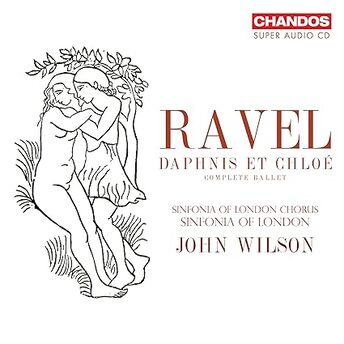
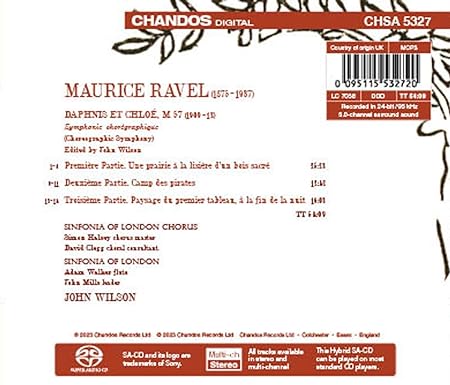
​It’s possible my expectations were set too high for this release. I wasn’t overly impressed with John Wilson’s earlier Ravel recording (2022), but his Rachmaninoff Third was so superb (and the collection of works by Kenneth Fuchs so spectacular), I eagerly anticipated his complete Daphnis and Chloe, which is one of my all-time favorite orchestral works.
 
I suppose it was inevitable I would be disappointed.
 
I believe I have on my shelves every commercially produced stereo recording of this ballet ever issued on CD. There have been many good ones, and more than a few unacceptable ones. But over the decades, there are just three which I consider to be the very best recordings ever made of the complete ballet: Munch/Boston/RCA (1955); Dutoit/Montreal/Decca (1980); and my favorite of all, Ozawa/Boston/DG (1974).
 
This new Chandos recording is offered on SACD and thus invites comparison with two other recent SACDs (from BIS and Pentatone) - which I will get to below.
 
Listening to Wilson’s account with his hand-picked Sinfonia of London, yes, I was disappointed. Overall, I found the reading to be just that - a reading. Wilson sounds rather impassive, somewhat cold and calculated, and in general, in a hurry to get it over with. (Incidentally, I heard many of these same characteristics in his previous Ravel recording). Sensuousness isn't important to Wilson, nor is the spirit of the dance. And unfortunately, the Chandos engineers don’t achieve the spectacular sonics we’re used to hearing from this orchestra. I presume squeezing a chorus onto the stage (along with extra wind and percussion players required in the score) necessitated a much different microphone configuration and the results are not nearly as successful as usual.
 
Detailed below are some examples which illustrate these general observations.
 
First and foremost, tempos are a concern throughout - especially in the First Part. The Danse religieuse (track 2), marked Modera un peu plus lent (“moderate and a little slow”) is simply too fast and feels rushed. Conversely, the following section (tr. 3), marked Vif ("fast"), is slow and a bit sluggish. As is the subsequent Danse general (tr. 4) - also marked Vif. Tempos are unvarying and indolent, and the music-making takes on a wooden blandness. I’m baffled by this. These tempo indications are pretty straight-forward and should be fairly easy to bring off.
 
The Danse grotesque de Dorcon (tr. 5) is better, but all those little string gestures are too matter-of-fact and rushed by with scant regard. And I’m beginning to really miss some of the magic and sensuousness inherent in this music. Daphnis’s Danse (tr. 6) is full of color and atmosphere (as to be expected from a Chandos production), but here I’m missing some of the ecstasy and fantasy. And at Figure 53, an opportunity for pure magic if ever there was one, Wilson produces an exquisite ppp - the likes of which I have never heard an orchestra execute so successfully - but irritatingly rushes through it heartlessly. It’s marked LENT ("very slow"), which he ignores for no apparent reason, as if in a hurry to get to the next section.
 
The Danse de lyceion (tr. 7) is under-characterized as Wilson forges ahead without much consideration. However, in the Modere at Figure 70 (the section which begins with ppp string trills), at last we hear what this orchestra is capable of. The truly soft playing is impressive, as is the superbly mysterioso flute solo. It is followed by the most exquisite (and surely the most difficult and feared in all the repertoire) horn solo imaginable. The diminuendo up to high C at the end of the phrase is positively ravishing as played here, with an effortless legato and at a true pianissimo. Oh my goodness - exquisite is the only word for it. This entire scene is magical and atmospheric and, in hindsight, is probably the most satisfactory of the entire reading. But in the Nocturne (tr. 8), Wilson is restless rather than hypnotic, diminishing some of its mesmerizing, rhythmic insistence. (And the wind machine is very faint, way back in the mists.)
 
Part Two is introduced by the chorus (tr. 9) and they manage an impressive crescendo as the War Danse erupts (tr. 10). Wilson adopts a cracking tempo (appropriately so) and at last the adrenaline begins to flow. I am aware here, though, of the over-reverberant acoustic, which becomes a bit distracting (and noisy), burying many of the fast moving, intricate details. (“Swampy” even comes to mind, which is most unusual for Chandos). And as the Pirates' Danse heats up, the men of the chorus are subdued, faithfully adhering to Ravel's pp marking. But as the climax reaches its peak, where they are marked ff, they are completely drowned out by the cacophony coming from the orchestra. This is surely the fault of the engineers who simply did not achieve an ideal microphone placement.
 
Chloe’s Dance of Supplication (tr. 11) is another beautifully played section, including an exquisite English Horn solo and some of the most sumptuous string playing heard thus far. I just wish Wilson had encouraged it more often.
 
Part Three arrives and we are in very familiar territory. Wilson paces it broadly, but frustratingly, much of the seductive, gossamer filigree and beguiling details go by without notice, buried in the reverberant haze. As is the chorus, which remains exasperatingly indistinct. The enormous sunrise climax erupts just as it should (although not without a bit of congestion) and for once, Wilson doesn't rush through it. But I could do without the weird, frantic, mega-fast vibrato he elicits from his violins - which is wholly inappropriate here.

The ensuing glow fades gracefully into the seductive Pantomime (tr. 13), which features a glorious flute solo played by Adam Walker (whose radiant tone, incredible breath control and dynamic range are wonders to behold), followed by a spectacularly executed passage involving the entire flute section. It was enlightening to actually hear the 2nd flute’s arpeggiated flourishes responding to the first flute’s trills at Figure 170 (which usually go by completely unnoticed), and the interplay among all the flutes (and piccolo) is expertly executed. 

But then, Wilson infuriatingly rushes through the Tres Lent immediately following it, at Figure 188, obviously in a great big hurry to get to the finale, where he simply unleashes the orchestra to do what they will. And they dutifully take off at breakneck speed. But, curiously, it's not all that exciting; it’s just fast. And civilized. What's sorely missing is wanton abandon. And the chorus lacks fervor, submerged back in the mix (cramped over on the left side). And in the helter-skelter race to the finish line, the chorus is overwhelmed by the orchestra, drowned out completely in the ruckus, undermining the impact of what should be one of the most thrilling conclusions ever composed. This music should be orgiastic; but Wilson seems content letting his orchestra make a virtuoso showpiece out of it. And that it certainly is.
 
I have mentioned along the way some of the shortcomings of the recorded sound, and they are significant. In general, the acoustic is more reverberant than typical for Chandos, revealing the vast, empty church in which it was recorded. This is most unfortunate. Orchestral impact and inner details suffer. And time after time, I longed to hear the percussion (especially the timpani) make a stronger rhythmic contribution and dramatic impact. And the brass only occasionally burst forth with real authority. These sections of the orchestra sound to be way back in the stage, far away from the nearest microphone (while, oddly, I noted the flutes were too closely mic’d). Finally, I was bothered by the placement of the chorus, bunched over on the left side of the soundstage most of the time, which rather restricted their ability to produce a potent body of sound. 

                                                                                                          +++++++++++++++

Comparing this new Chandos to two other recent SACDs is enlightening. Turning first to Yannick Nezet-Seguin’s 2015 complete recording with the Rotterdam Philharmonic on BIS (not to be confused with his 2009 EMI recording of just the 2nd Suite with the same orchestra), matters improve - but not that much, frankly. I wasn’t terribly impressed with this reading when it was first issued, and listening to it again, I’m still not. The recorded sound is clearer than the Chandos, to great advantage. However, there is a different problem here. Dynamic extremes are so wide, it’s difficult to enjoy in a home listening environment. The softs are so soft, they’re virtually inaudible. Cranking up the volume then results in distortion overload as the music crescendos. I found it impossible to find an acceptable volume setting and was constantly grabbing the remote to adjust it up and down. This was impossibly distracting and very annoying. However, it’s very well played and tempos are more sensible than Wilson’s. YNS coaxes some sensuous playing from the strings and the chorus is more robust as well, increasing dramatic effect.
 
I was happy to reacquaint myself with the 2017 recording with Gustavo Gimeno conducting the Luxembourg Philharmonic Orchestra on Pentatone. I reviewed this disc several years ago, and while I thought the performance was one of the best in recent decades, I had some issues with the dark, slightly murky sound. Well, listening to it again, 6 years later, it sounds better than I remember. In my current system, this Pentatone is easily the best-sounding of the 3 SACDs under evaluation here. In fact, I was astonished to hear the rhythmic precision and incisive articulation in the playing - far and away better than with Wilson or Nezet-Seguin. The orchestra has more presence, with a much more natural (and manageable) dynamic range, and makes a splendid impact.
 
Even more notably, Gimeno displays an intrinsic feel for this music which quite eludes John Wilson. It is everywhere apparent that this is ballet music and there is a story to tell. Gimeno brings out the sensuousness of this music, while generating excitement in all the right places. His strings are sumptuous, his chorus is the most clarified and impactful by far, and he encourages virtuosic, soloistic bravura from his principal players. The engaging and immersive involvement heard in this recording is positively thrilling, illustrating exactly what is lacking in the other two.

While none of these new recordings matches Ozawa or Dutoit (sonically, musically, or for sheer orchestral prowess), Gimeno's is by far the most satisfying of the 3 recent SACDs.

                                                                                                  +++++++++++++++++

The Chandos booklet informs us that John Wilson spent a lot of time preparing a newly edited version of this score. By comparing the individual orchestral parts to the published score and Ravel's original manuscript, Wilson identified and corrected “hundreds” of discrepancies and errors. And this is actually enlightening. Listening to his recording reveals a fixation on the notes, at the expense of the music. Wilson's preoccupation with the printed page tends to highlight the detached, matter-of-fact nature of his conducting. And I believe this encapsulates my general dissatisfaction with it.
 
In the end, this Chandos release isn't as “horrible” as Dave Hurwitz (of ClassicsToday.com) proclaims it to be on his YouTube review of it (although I don't disagree with his criticisms). Nor is it anywhere near as fabulous as Gramophone magazine (and others) would like us to believe. In my view, it falls squarely in the middle, like so many others before it.
1 Comment
YB Schragadove
1/2/2024 12:22:22 pm

David, great blog, and your collection and audio system are impressive! It's interesting how Wilson's Daphnis has generated quite disparate opinions, as you point out. British (Gramophone) as well as Australian (Limelight) critics have raved about it, while Dave Hurwitz included it in his end-of-year "Avoid Like Death" awards, giving it a "Scarlet Scarf of Shame". Thank you for your detailed review covering musical specifics as well as the issues with the recorded sound.

Happy New Year!

Reply


Leave a Reply.

    Author

    David Rowe

    Categories

    All

    RSS Feed

Proudly powered by Weebly